Columna
¿Por qué meter cemento en una vértebra fracturada podría bajar el dolor?
Contenido docente; no es una recomendación de tratamiento. La vértebra por dentro, cómo se fractura, qué se hace en la vertebroplastia y la cifoplastia, y qué se sabe y qué no.
Míralo paso a paso
Paso 1 de 9
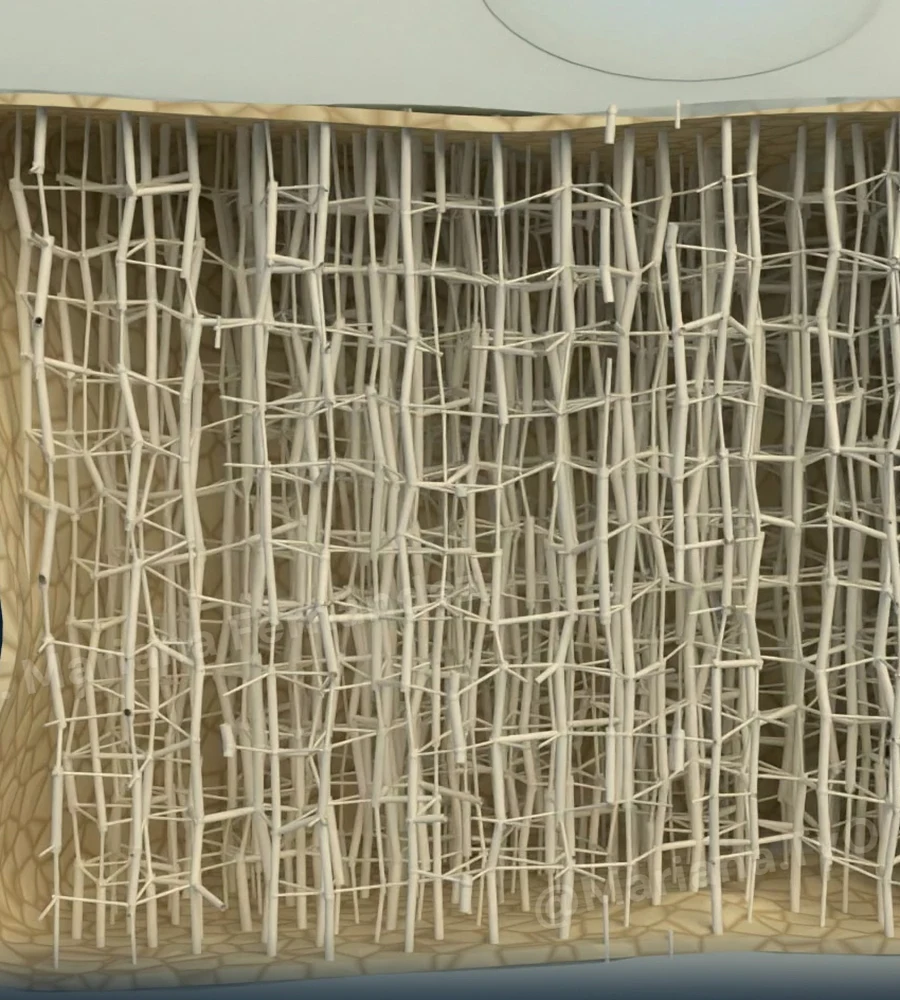
Primero, la vértebra por dentro: cortical y trabéculas
El cuerpo vertebral tiene una cáscara delgada, la cortical, de unos 0.35 mm, más gruesa adelante que atrás [1]. Dentro hay hueso trabecular: columnas verticales unidas por puentes horizontales, las trabéculas [2]. Con osteoporosis hay menos trabéculas, más delgadas y más separadas [2][3]. En vértebras osteoporóticas se midieron grosores de 150 a 185 µm y separaciones de 550 a 580 µm [4]. En el esquema se dibujan más gruesas de lo real para que se vean, y no está establecido qué orientación se pierde primero.
Tip: también puedes usar las flechas del teclado.
Velo en video
El video se publica el 28 de noviembre
Mientras tanto, aquí arriba está todo su contenido paso a paso.
Lo que casi nadie te explica
Las guías no coinciden. La NASS 2024 recomienda el aumento vertebral en fractura aguda (grado A) [29]. La guía del Reino Unido 2024 no lo recomienda de rutina [11], y la ASBMR 2019 no apoya su uso rutinario [30].
Entre cifoplastia y vertebroplastia, dolor y función son equivalentes. La cifoplastia corrige más la altura, pero esa corrección no ha mostrado menos dolor [29][31][32]. Aquí ninguna se presenta como mejor.
La fuga de cemento es frecuente en la tomografía y casi siempre no da síntomas: entre 4 y 39 % de las personas según el comparador [27] y hasta 80 % de las vértebras en VERTOS II [33]. El cemento que llega al pulmón se reporta en 2.1 a 26 %, casi siempre sin síntomas; el sintomático es una urgencia [34].
El cemento sostiene una vértebra, pero no trata la osteoporosis, y el riesgo de otra fractura es mayor justo después de la primera [11].
En pocas palabras
- Por dentro, la vértebra tiene una cortical delgada y trabéculas; con osteoporosis se adelgazan, se separan y se pierden.
- Cuando cede, lo hace primero adelante: cuña o platillo hundido. La resonancia muestra edema en la fractura reciente.
- Primero va lo conservador (analgésicos, movilización, corsé según el caso) y siempre se trata la osteoporosis.
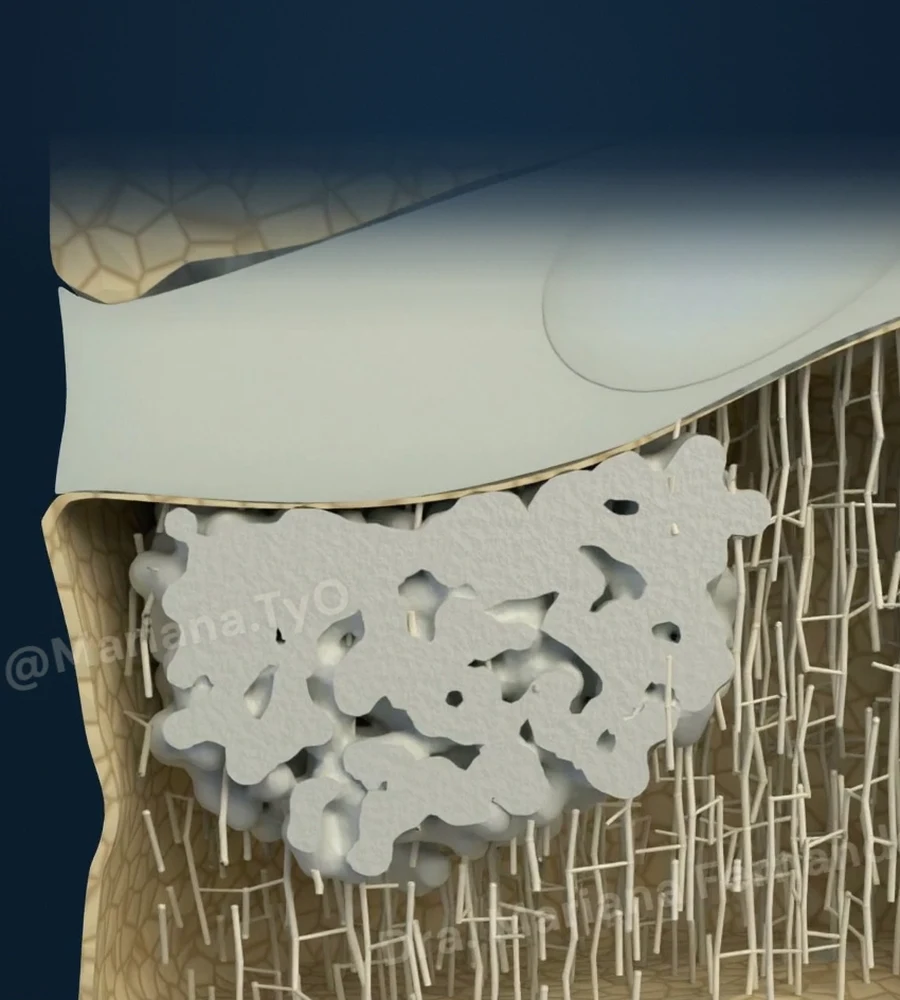
- En ambas técnicas, un trocar con su cánula cruza el pedículo bajo imagen en vivo. En la vertebroplastia se inyecta cemento; en la cifoplastia, primero un balón deja una cavidad y luego va el cemento.
- Lo demostrado sobre el posible alivio es mecánico y de cadáver. Presión, calor y nervio basivertebral son hipótesis, y en personas no está probado.
- Es un tema docente: explica una técnica y lo que se sabe de ella. No recomienda un procedimiento.
Cuándo conviene que te revisen
Esta página explica una técnica y lo que se sabe de ella; no recomienda ningún procedimiento ni sustituye una revisión médica. Debe revisarte un médico pronto si hay:
- Debilidad o adormecimiento de las piernas, o problemas para orinar [10].
- Fiebre, antecedente de cáncer o una fractura en una persona joven sin causa clara [10].
- Falta de aire o dolor de pecho después de un procedimiento de este tipo [34].
La doctora Mariana te valora y te explica tus opciones
Agendar una valoración por WhatsAppFuentes
- Silva MJ, Wang C, Keaveny TM, Hayes WC. 1994. Direct and computed tomography thickness measurements of the human, lumbar vertebral shell and endplate. Bone 15(4):409-414. Ver fuente
- Snyder BD, Piazza S, Edwards WT, Hayes WC. 1993. Role of trabecular morphology in the etiology of age-related vertebral fractures. Calcified Tissue International 53(Suppl 1):S14-S22. Ver fuente
- Thomsen JS, Ebbesen EN, Mosekilde Li. 2002. Age-related differences between thinning of horizontal and vertical trabeculae in human lumbar bone. Bone 31(1):136-142. Ver fuente
- Schröder G, Mittlmeier T, Gahr P, et al. 2024. Regional Variations in the Intra- and Intervertebral Trabecular Microarchitecture of the Osteoporotic Axial Skeleton. Diagnostics 14(5):498. Ver fuente
- Donnally CJ III, Margetis K, Varacallo MA. 2025. Vertebral Compression Fractures. StatPearls. Ver fuente
- Landham PR, Baker-Rand HL, Gilbert SJ, et al. 2015. Is kyphoplasty better than vertebroplasty at restoring form and function after severe vertebral wedge fractures? Spine Journal 15(4):721-732. Ver fuente
- Luo J, Bertram W, Sangar D, et al. 2010. Is kyphoplasty better than vertebroplasty in restoring normal mechanical function to an injured spine? Bone 46(4):1050-1057. Ver fuente
- Luo J, Annesley-Williams DJ, Adams MA, Dolan P. 2017. How are adjacent spinal levels affected by vertebral fracture and by vertebroplasty? Spine Journal 17(6):863-874. Ver fuente
- Ortiz AO. 2008. Vertebral body reconstruction: Review and update on vertebroplasty and kyphoplasty. Applied Radiology 37(12):10-24. Ver fuente
- McCarthy J, Davis A. 2016. Diagnosis and Management of Vertebral Compression Fractures. American Family Physician 94(1):44-50. Ver fuente
- Gregson CL, Armstrong DJ, Avgerinou C, et al. 2025. The 2024 UK clinical guideline for the prevention and treatment of osteoporosis. Archives of Osteoporosis 20(1):119. Ver fuente
- Venmans A, et al. 2012. VERTOS II, seguimiento de las fracturas tratadas sin operar (dolor a un año). AJNR 33(3):519-521. Ver fuente
- RadiologyInfo.org (ACR y RSNA). Revisado en 2026. Vertebroplasty & Kyphoplasty. Ver fuente
- Nasto LA, Jannelli E, Cipolloni V, et al. 2022. Three generations of treatments for osteoporotic vertebral fractures: what is the evidence? Orthopedic Reviews 14(6):38609. Ver fuente
- Omidi-Kashani F. 2014. Percutaneous vertebral body augmentation: an updated review. Surgery Research and Practice 2014:815286. Ver fuente
- Krüger A, Oberkircher L, Kratz M, et al. 2012. Cement interdigitation and bone-cement interface after augmenting fractured vertebrae: a cadaveric study. International Journal of Spine Surgery 6:115-123. Ver fuente
- Luo J, Daines L, Charalambous A, et al. 2009. Vertebroplasty: only small cement volumes are required to normalize stress distributions on the vertebral bodies. Spine 34(26):2865-2873. Ver fuente
- Yokoyama K, Kawanishi M, Yamada M, et al. 2012. Comparative Study of Percutaneous Vertebral Body Perforation and Vertebroplasty. AJNR 33(4):685-689. Ver fuente
- Belkoff SM, Molloy S. 2003. Temperature measurement during polymerization of polymethylmethacrylate cement used for vertebroplasty. Spine 28(14):1555-1559. Ver fuente
- Deramond H, Wright NT, Belkoff SM. 1999. Temperature elevation caused by bone cement polymerization during vertebroplasty. Bone. Ver fuente
- Bailey JF, Liebenberg E, Degmetich S, Lotz JC. 2011. Innervation patterns of PGP 9.5-positive nerve fibers within the human lumbar vertebra. Journal of Anatomy. Ver fuente
- Buchbinder R, et al. 2018. Percutaneous vertebroplasty for osteoporotic vertebral compression fracture. Cochrane Database of Systematic Reviews 11:CD006349. Ver fuente
- Buchbinder R, et al. 2009. A randomized trial of vertebroplasty for painful osteoporotic vertebral fractures. New England Journal of Medicine 361(6):557-568. Ver fuente
- Kallmes DF, et al. 2009. A randomized trial of vertebroplasty for osteoporotic spinal fractures. New England Journal of Medicine 361(6):569-579. Ver fuente
- Firanescu CE, et al. 2018. Vertebroplasty versus sham procedure for painful acute osteoporotic vertebral compression fractures (VERTOS IV). BMJ 361:k1551. Ver fuente
- Dutra MNP, Canez MS, Pereira BR, et al. 2026. Invasive Procedures for Most Musculoskeletal Conditions Are Not Better Than Placebo: A Systematic Review With Meta-Analysis. Musculoskeletal Care 24(3):e70244. Ver fuente
- Ontario Health. 2025. Percutaneous Vertebroplasty and Balloon Kyphoplasty for Painful Osteoporotic Vertebral Compression Fractures: A Health Technology Assessment. Ontario Health Technology Assessment Series 25(4):1-253. Ver fuente
- Li Y, et al. 2025. Optimal management for osteoporotic vertebral compression fractures: a network meta-analysis. Journal of Orthopaedic Surgery and Research. Ver fuente
- North American Spine Society. 2024. Evidence-Based Clinical Guidelines for Multidisciplinary Spine Care: Diagnosis and Treatment of Adults with Osteoporotic Vertebral Fractures. Ver fuente
- Ebeling PR, et al. 2019. Second ASBMR Task Force Report. Journal of Bone and Mineral Research 34(1):3-21. Ver fuente
- Dohm M, et al. 2014. Ensayo KAVIAR, cifoplastia con balón frente a vertebroplastia. AJNR 35(12):2227-2236. Ver fuente
- Daher M, et al. 2025. Kyphoplasty vs vertebroplasty, metaanálisis de ensayos. Journal of Bone and Joint Surgery (Am). Ver fuente
- Venmans A, et al. 2011. VERTOS II, fuga de cemento. Neuroradiology 53(1):19-22. Ver fuente
- Wang LJ, Yang HL, Shi YX, et al. 2012. Pulmonary cement embolism associated with percutaneous vertebroplasty or kyphoplasty: a systematic review. Orthopaedic Surgery 4(3):182-189. Ver fuente